

Contents
| Section | Title | Purpose |
|---|---|---|
| 1 | General Principles | Authority, scope, hierarchy, and expectations |
| 2 | Conduct | Community standards on the platform, Discord, app, website, and track |
| 3 | Official Racing and Divisions | What official means for leagues, divisions, races, sheets, and results |
| 4 | Results, Rankings, and OFR Rating | Publishing, official filters, standings, and rating policy |
| 5 | Competition | Entry, eligibility, event integrity, and fair participation |
| 6 | Race Procedures | Starts, restarts, pit lane, safety periods, and session conduct |
| 7 | Flag Signals | Default OFR flag meanings and division-level override points |
| 8 | Driving Standards | Racecraft, overtaking, defending, rejoining, blue-flag etiquette |
| 9 | Reports, Stewarding, Penalties, and Appeals | Reporting channels and case workflow |
| 10 | Definitions and Quick Reference | Glossary and default rule hierarchy |
This document intentionally combines the material that many sporting codes separate into licence class, penalties, protests, and appeals. OFR is a league platform with division-specific rulebooks, so the central code is written as an enforceable baseline and an operating manual rather than a full game-specific race-control book.
01 General Principles
1.1.1. Online Formula Racing, referred to in this document as OFR, is a racing league platform and community for organised online motorsport competition.
1.1.2. OFR provides league, division, event, result, ranking, setup, report, penalty, notification, app, website, API, and Discord bot tooling for participating leagues and drivers.
1.1.3. This Sporting Code is the OFR-wide baseline. It applies to OFR-hosted activity and to any race, division, report, result, ranking, notification, or stewarding workflow presented as part of OFR.
1.1.4. The code exists to make racing fair, consistent, reviewable, and respectful. It is not intended to replace common sense, race control instructions, or a division's game-specific procedures.
1.2.1. OFR may revise this code. A revision takes effect when published through an official OFR channel or adopted by the relevant league or division owner.
1.2.2. Division rulebooks may add stricter rules, define game-specific procedures, or override specific sporting rules such as blue-flag handling, qualifying format, steward panel size, tyre rules, reset rules, or safety car procedure.
1.2.3. A division override must be clear enough that a reasonable driver can understand the rule before joining the event. Ambiguous overrides are interpreted narrowly.
1.3.1. Every driver is responsible for reading and following this code and any division rulebook that applies to the race they enter.
1.3.2. A driver may not avoid responsibility by claiming that the game allowed an action, that the action was technically possible, or that a rule was not enforced automatically.
1.3.3. League owners, admins, managers, stewards, and head stewards are expected to enforce rules consistently, disclose conflicts where reasonable, and keep decisions grounded in evidence.
1.3.4. OFR may treat repeated borderline conduct as a pattern. A pattern of avoidable contact, abuse, unsafe rejoining, bad-faith reporting, or deliberate rule exploitation may be penalised even when each individual incident appears minor.
Official OFR Channels
- The OFR website and mobile app are official platform surfaces for results, rankings, league/division pages, event details, reports, penalties, notifications, and authorised portal tools.
- The OFR Discord bot and supported Discord interactions are official workflow surfaces where they issue commands, reports, notifications, login tokens, or stewarding actions.
- A participating league's Discord server may be an official communications surface for that league when the league owner or division organiser designates it as such.
- Private messages, voice chat, livestream chat, or external platforms may be considered evidence, but they are not a substitute for filing a report through a supported OFR channel unless a division rulebook says otherwise.
1.4.1. OFR staff and authorised league/division officials may take reasonable administrative action to protect the platform, including restricting access, correcting obvious data errors, removing abusive content, or pausing a workflow while evidence is reviewed.
1.4.2. Suspended users may be blocked from authenticated API endpoints, mobile app portal actions, website portal actions, Discord bot commands, component interactions, modal submissions, and login-token issuance.
02 Conduct
2.1.1. Members must treat drivers, league staff, stewards, streamers, spectators, guests, and OFR operators with respect on and off the track.
2.1.2. Abuse, threats, harassment, targeted ridicule, slurs, intimidation, doxxing, malicious impersonation, and sustained hostile behaviour are prohibited.
2.1.3. Competitive frustration is not a defence. Drivers are expected to cool down before posting, messaging, or entering voice channels after an incident.
2.1.4. Constructive criticism is welcome when it is specific, respectful, and aimed at improving the racing or the platform. Public pile-ons, bad-faith accusations, and repeated hostility are not.
2.2.1. Drivers must compete honestly. Sandbagging, collusion, deliberate manipulation of results, intentional disconnections, false identity use, unauthorised account sharing, or knowingly exploiting a platform defect may result in penalties or removal.
2.2.2. A driver must not deliberately wreck, retaliate, brake-check, crowd, block, or intimidate another competitor.
2.2.3. A driver must not use reports, appeals, Discord moderation, or public accusations as a weapon against another competitor.
2.3.1. Voice and text channels must remain suitable for an organised racing environment. Drivers may disagree firmly, but must not be abusive.
2.3.2. Race control instructions, steward notices, briefing notes, and official event messages must not be drowned out by arguments or repeated irrelevant messages.
2.3.3. A league or division may define stricter voice, push-to-talk, stream-delay, or text-chat rules for its events.
Evidence and Public Conduct
2.4.1. Screenshots, clips, telemetry, replay files, logs, Discord messages, and app/website records may be considered evidence.
2.4.2. Editing evidence in a way that changes its meaning, withholding requested context, or submitting knowingly false evidence is itself a breach.
2.4.3. Drivers should avoid public verdicts before a report is decided. Public discussion may continue, but naming, shaming, or pressuring stewards is prohibited.
03 Official Racing and Divisions
3.1.1. An OFR league is an organised competition group represented on the OFR platform. A league may contain multiple divisions, games, cars, formats, and seasons.
3.1.2. An OFR division is a rule-bearing competition unit inside a league. Divisions may differ by game, car, assists, schedule, race format, licence expectations, steward panel, or driving standards.
3.1.3. A division rulebook may override racing-specific defaults in this code when the override is explicit. It may not override OFR platform security, conduct, account suspension, result integrity, evidence integrity, or report tampering rules unless OFR expressly authorises that override.
3.2.1. A race is official for OFR platform purposes when it is an event in an OFR division and its results are entered, accepted, or published through authorised OFR tools.
3.2.2. A division marked official represents a division whose championship results are intended to count as formal OFR competition rather than preseason, testing, casual, or exhibition activity.
3.2.3. A result sheet marked official is a technical record that meets OFR's minimum data threshold. By default, a qualifying sheet requires at least five drivers. A race sheet requires at least five drivers and the race leader must have completed at least five laps or at least 300 seconds of race time.
3.2.4. A published result is a result released by an authorised division manager, league admin, or league owner through the OFR publish-results workflow. Republished results may be restricted by a cooldown to protect drivers from repeated notification noise.
3.2.5. A race can be part of an official division while one or more sheets remain non-official for technical ranking or rating purposes. Conversely, a result being visible does not automatically mean it counts for every official filter.
| Term | Default Meaning | Common Effect |
|---|---|---|
| Official division | Division flag indicates formal OFR competition. | May affect championship wording, rankings, stats, and title treatment. |
| Official sheet | Qualifying or race data meets the minimum driver and race-completion thresholds. | Can be admitted to official-only rankings, stats, and OFR Rating. |
| Published result | Authorised staff released event results on OFR. | Drivers can view current result pages and may receive notifications. |
| Non-test league | League is not marked as a test league. | Eligible for normal public rankings and OFR Rating rebuilds. |
3.3.1. League and division owners are responsible for making entry criteria visible before a driver is expected to comply with them.
3.3.2. Entry criteria may include registration status, Discord membership, driver number, team assignment, licence or safety requirements, availability, platform account status, region, assists, connection quality, or previous conduct.
3.3.3. OFR account registration may be handled through participating Discord communities. A user should not create duplicate accounts to avoid penalties, suspensions, driver-number conflicts, or stewarding history.
3.4.1. A division may run preseason, test, charity, one-off, showcase, or exhibition events. Those events must be labelled clearly when their results do not count in the same way as normal official championship rounds.
3.4.2. When a division rulebook does not define an issue, the OFR default is to preserve fair competition, protect other drivers from avoidable harm, and prefer a decision that can be explained from evidence.
04 Results, Rankings, and OFR Rating
4.1.1. Event results may include qualifying sheets, race sheets, incidents, report records, steward votes, penalties, penalty service status, stream links, track details, division details, and published status.
4.1.2. Results should be entered accurately and corrected promptly when an authorised official identifies a data error.
4.1.3. A driver must not knowingly submit, encourage, or benefit from false result data.
4.1.4. If game exports, screenshots, manual entry, and replay evidence conflict, stewards or authorised managers should resolve the inconsistency using the most reliable evidence available and record the reason where practical.
4.2.1. OFR rankings are server-driven. The platform may expose rankings globally, by league, by division, or by game depending on the ranking type.
4.2.2. Official-only ranking filters use the ranking's supported filters. For default driver wins, points, race entries, pole positions, and COTWs, the official filter may restrict results to official sheets and eligible official divisions.
4.2.3. Driver OFR Rating is league-scoped only. It is calculated from official race sheets in non-test leagues and does not accept division or game filters.
4.2.4. OFR Rating starts drivers at a base rating and rebuilds from official race history. The rebuild is designed to be deterministic, chronological, and transactional so readers do not see partial rating updates.
4.2.5. OFR Rating is not the sole measure of driver quality. It is a statistical tool for league context, not a substitute for steward decisions, entry criteria, or division-specific licence rules.
| Ranking | Value | Scopes | Official Filter |
|---|---|---|---|
| Driver wins | Wins | Global, league, division, game | Supported |
| Driver points | Points | Global, league, division, game | Supported |
| Driver race entries | Entries | Global, league, division, game | Supported |
| Driver pole positions | Poles | Global, league, division, game | Supported |
| Driver COTWs | COTWs | Global, league, game | Supported |
| Driver OFR Rating | Rating | League only | Not a toggle; rating source is already official race sheets |
4.3.1. Driver standings and team standings are division records. A division rulebook may define dropped rounds, bonus points, points deductions, substitution rules, team rules, and tie-breakers.
4.3.2. When a division is active, the leading driver may be presented as championship leader. When a division is concluded, the leading driver may be presented as championship winner. Official divisions may use stronger OFR championship wording than non-official divisions.
4.3.3. A standing shown on the app or website is only as authoritative as the latest accepted data. Pending reports, unserved penalties, or unpublished corrections may still affect final classification.
4.4.1. Publishing event results may notify drivers. A manager republishing results should do so only to correct meaningful data, reflect steward decisions, or release a materially updated result.
4.4.2. A driver who believes a published result is wrong should use the reporting, additional-info, or league-defined correction process rather than starting a public argument.
05 Competition
5.1.1. Drivers must enter events under the account and identity approved for that league or division.
5.1.2. Drivers must use the correct car, team, driver number, platform account, assist settings, livery, and setup restrictions required by the division rulebook.
5.1.3. Drivers must not enter a session if they know they are unable to race with a stable connection, the required hardware, the correct game version, or the correct event configuration.
5.1.4. A driver who joins late, disconnects, or rejoins after a failure remains responsible for avoiding disruption.
Event Briefings
5.2.1. A briefing may define session order, lobby settings, weather, assists, formation lap, restart rules, safety car procedure, pit requirements, tyre rules, corner-cut limits, and report deadlines.
5.2.2. Briefing instructions apply to that event and prevail over default OFR racing procedures when they are clear and issued by an authorised organiser.
5.2.3. A driver who did not attend or read the briefing remains responsible for complying with it.
Fair Participation
5.3.1. Drivers must make a genuine competitive effort unless withdrawing safely, serving a penalty, yielding under instruction, or avoiding an incident.
5.3.2. Team orders are permitted only where the division rulebook permits them and they do not create unsafe driving, manipulate stewarding evidence, or abuse game systems.
5.3.3. A driver may not deliberately influence a championship by failing to compete honestly, gifting positions outside allowed team strategy, or interfering with a rival's race.
5.3.4. A driver who parks, slows, or retires must do so safely and without affecting active competitors.
Connection and Technical Issues
5.4.1. Lag, desync, hardware failure, controller failure, or stream delay may explain an incident but does not automatically remove responsibility.
5.4.2. A driver experiencing repeated lag, erratic motion, or control failure must leave the racing line and may be required to retire.
5.4.3. A division may define restart thresholds for mass disconnects, lobby failures, game bugs, or safety-critical configuration errors.
06 Race Procedures
6.1.1. Drivers must follow the session format set by the division. A division may use practice, qualifying, sprint races, feature races, heat races, reverse grids, manual grids, or endurance formats.
6.1.2. Unless a division says otherwise, drivers should be ready before qualifying starts and must not intentionally delay the event.
6.1.3. A driver must not exploit qualifying out-laps, in-laps, reset behaviour, ghosting, pause menus, AI substitution, or timing bugs to gain an advantage.
Starts and Restarts
6.2.1. At race start, every driver must prioritise control, predictable line choice, and leaving racing room over maximising first-corner aggression.
6.2.2. A driver must not jump the start, brake-check the field, weave unpredictably, or overlap another car in a way that creates avoidable contact before the start signal.
6.2.3. On formation laps, drivers must maintain safe spacing, avoid unnecessary acceleration and braking, and respect the prescribed order.
6.2.4. On restarts, the leader or race control-defined control car may control the pace within the stated restart zone. Following drivers must not anticipate the restart by overlapping or launching early.
Pit Lane
6.3.1. Drivers entering or leaving pit lane must stay within pit entry and exit lines where the game or division defines them.
6.3.2. A driver exiting pit lane must not rejoin the racing line until it is safe. A driver on track should not deliberately crowd a car that is constrained by a pit-exit line.
6.3.3. Mandatory pit stops, tyre changes, refuelling, repairs, or penalty service rules are defined by the division rulebook or event briefing.
Safety Car and Neutralisation
6.4.1. Where a game or division uses a safety car, virtual safety car, full-course yellow, manual neutralisation, or red-flag procedure, drivers must follow race control and the game interface.
6.4.2. During neutralised periods, drivers must avoid sudden braking, unnecessary weaving, overtaking without permission, and contact with other cars.
6.4.3. A driver may not use a safety period to harass, intimidate, push, or damage another competitor.
Post-Race
6.5.1. The race is not a licence to cause contact after the finish. Cool-down laps, victory burnouts, and return-to-pit behaviour must not damage or disrupt other drivers.
6.5.2. Drivers should save evidence promptly if they may report, defend, or clarify an incident.
07 Flag Signals
7.1.1. Flag rules may be enforced by the game, race control, division rulebook, or stewards after review. A driver remains responsible for understanding how the relevant game presents flags.
| Signal | Default OFR Meaning | Driver Obligation |
|---|---|---|
| Green | Track or session is live. | Race normally and remain alert for local hazards. |
| Yellow | Danger, incident, or caution. | Slow if needed, avoid overtaking where prohibited, and be ready to change line. |
| Blue | Faster car approaching or lapping traffic. | Default is predictable cooperation; division rulebook may make it advisory or mandatory. |
| White | Slow vehicle ahead or final lap depending on game context. | Interpret by game context and proceed with caution. |
| Black | Penalty, disqualification, or race-control instruction. | Comply promptly with game/race-control requirement. |
| Black and orange | Mechanical damage or unsafe car. | Return safely to pit lane or retire if required. |
| Red | Session stopped or unsafe to continue. | Slow safely and follow race-control instructions. |
| Chequered | Session complete. | Finish the lap/session as directed and avoid post-race contact. |
7.2.1. Under yellow flags, drivers must not treat the incident area as an overtaking opportunity. Passing cars involved in the incident may be acceptable where safe and allowed by the game.
7.2.2. If the game issues a penalty for a yellow-flag pass, the driver must serve or challenge it through the proper division process rather than ignoring it.
7.3.1. A blue-flagged driver must remain predictable. Sudden braking, leaving the track unnecessarily, swerving off-line at the last second, or fighting a lapping car in a way that creates danger may be penalised.
7.3.2. A faster or lapping driver must complete the pass safely. A blue flag is not permission to force contact, dive without overlap, or demand that another driver vanish.
7.3.3. A division may define mandatory blue-flag yielding, advisory blue flags, class-based blue flags, multi-class pass zones, or game-specific blue-flag timing.
7.4.1. Black flags and penalty notices must be followed unless the division rulebook provides a clear protest or correction mechanism.
7.4.2. A driver who ignores a game-issued or steward-issued penalty may receive additional penalties, disqualification, or suspension.
08 Driving Standards
8.1.1. OFR expects hard but fair racing. Drivers may race aggressively when they remain in control, leave required space, and accept responsibility for avoidable risk.
8.1.2. Every driver must maintain awareness using mirrors, radar, proximity indicators, spotter calls, track map, relative timing, or other available tools.
8.1.3. A driver who loses control must prioritise reducing danger over recovering positions.
Overtaking
8.2.1. An overtaking driver is responsible for establishing a realistic overlap and attempting the pass from a position that can be completed without avoidable contact.
8.2.2. A defending driver is entitled to defend, but must leave racing room when another car has earned space under the division's overlap standard.
8.2.3. Late lunges, dive-bombs, or moves relying on the other driver to abandon the corner may be penalised even if the overtaking car reaches the apex.
8.2.4. Door-to-door racing requires both drivers to leave space where overlap exists. Squeezing a car onto grass, wall, kerb, gravel, or sausage kerb may be penalised.
Defending and Blocking
8.3.1. A driver may make one clear defensive move before the braking zone unless the division rulebook states a different standard.
8.3.2. Moving in reaction to a following car, weaving repeatedly, brake-testing, or changing line under braking in a way that removes reasonable reaction time is prohibited.
8.3.3. Returning toward the racing line after a defensive move is allowed only when it leaves sufficient room and does not create avoidable contact.
Rejoining and Recovery
8.4.1. A car rejoining from off-track, a spin, ghosting, reset, pit lane, or recovery position must not enter the racing line until safe.
8.4.2. Unsafe rejoining is one of the clearest forms of avoidable incident. Lack of visibility, panic, or desire to avoid losing positions is not a defence.
8.4.3. When recovering, a driver should hold brakes where appropriate, allow traffic to pass, and rejoin parallel to track direction rather than across the racing surface.
Contact and Fault
8.5.1. Racing incidents may occur without penalty where both drivers made reasonable decisions and the outcome was not caused by careless, reckless, or malicious behaviour.
8.5.2. A driver may be penalised for avoidable contact, forcing another car off track, gaining a lasting advantage through contact, or failing to return a position where required.
8.5.3. Retaliation is prohibited. A driver who believes they were wronged must report through the proper channel.
Track Limits and Advantages
8.6.1. Track limits are defined by the game unless the division rulebook or event briefing defines a stricter standard.
8.6.2. A driver who leaves the racing surface must not gain a lasting advantage. This includes time, position, tyre temperature, fuel advantage, or tactical advantage.
8.6.3. Repeated corner cutting, wall-riding, reset exploitation, ghosting abuse, or abuse of invalidation mechanics may be penalised even if the game does not apply a sufficient penalty.
Multi-Class and Traffic
8.7.1. In multi-class events, faster-class cars are responsible for planning safe passes. Slower-class cars are responsible for predictability.
8.7.2. A slower-class car is not required to compromise its own race by disappearing from the racing line unless the division rulebook says so.
8.7.3. A faster-class car must not treat traffic as a moving obstacle. Contact caused by impatience in traffic is normally avoidable.
09 Reports, Stewarding, Penalties, and Appeals
9.1.1. Reports are the official OFR mechanism for asking stewards to review an incident, result issue, conduct issue, or penalty matter.
9.1.2. Reports must be submitted through the OFR app or OFR website. Discord is no longer a normal report-submission channel; divisions may use Discord only to direct drivers to the app or website, or for emergency staff communication where the platform is unavailable.
9.1.3. By default, a report can only be submitted for a past event by a driver in that event's division, and it must identify at least one reported driver when the report concerns driver conduct.
9.1.4. A report should select the correct past event, identify the reported driver or drivers, include a media link or replay reference where available, and provide a concise description with any immediate context needed to understand the incident.
9.1.5. Reported users, involved users, stewards, and authorised staff may receive notifications through supported push or Discord channels according to their notification preferences.
Report Workflow
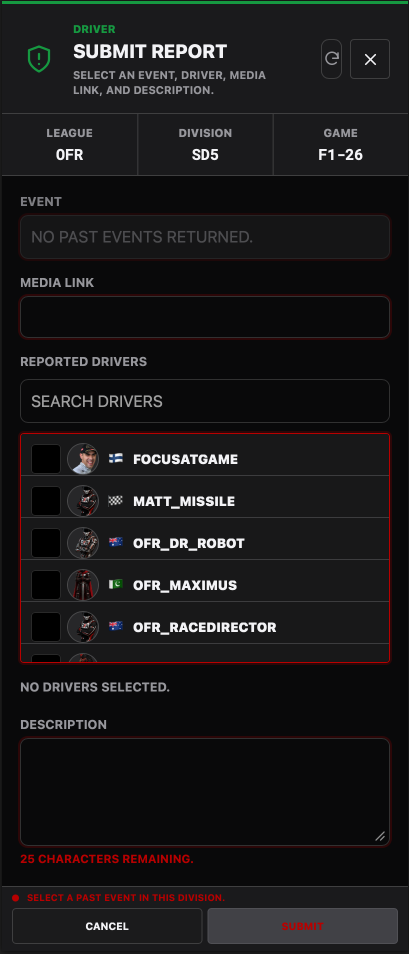
- Driver submits a report in the OFR app or website against one or more involved users for a past division event.
- The platform records the report, notifies involved parties, and alerts stewards who need to vote.
- Involved drivers or authorised officials may add additional information.
- Division stewards review evidence and submit votes where the division uses the OFR voting workflow.
- A head steward or authorised owner/admin records final penalties when required.
- Penalties remain visible with the event and division records and may be tracked until served.
- When all final penalties are served or the matter is otherwise closed, the report may be treated as closed for platform purposes.
9.2.1. A steward must decide based on evidence, the division rulebook, this code, and the balance of probability. Personal dislike, championship position, friendship, or public pressure must not influence the decision.
9.2.2. A steward with a clear conflict should not vote unless the division rulebook requires a different process due to limited staffing.
9.2.3. A head steward may create, change, serve, or delete penalties only through authorised workflows and within the division's authority structure.
9.2.4. Deleting a report after penalties exist is normally prohibited. A report may be marked inactive or corrected only through authorised tools.
| Role | Default Authority | Examples |
|---|---|---|
| Driver | Submit reports and additional info for eligible events. | Incident report, evidence link, clarification statement. |
| Steward | Vote on reports in assigned divisions. | Penalty/no-penalty recommendation with description. |
| Head steward | Manage final report penalties. | Add, change, serve, or remove penalty records where allowed. |
| Division manager | Manage division operations and event results. | Events, drivers, results, publishing, division services. |
| League owner/admin | Manage league or delegated division operations. | Privileges, divisions, publishing, user management. |
Penalty Principles
9.3.1. Penalties should be proportionate to the conduct, consequence, intent, prior pattern, and available mitigation.
9.3.2. A penalty may address the race result, future event eligibility, licence/role access, championship points, grid position, race time, drive-through/stop-go service, warnings, suspensions, or platform access.
9.3.3. A driver may receive a stronger penalty for intentional, retaliatory, dishonest, abusive, or repeated conduct.
9.3.4. A driver may receive a reduced penalty where they clearly attempted to avoid contact, gave back an advantage, self-reported, or accepted responsibility promptly.
9.3.5. A penalty may be marked served against a qualifying or race sheet. If a penalty is not served, it may remain in unserved penalty checks and steward task lists.
Appeals and Reviews
9.4.1. A division rulebook may define appeal rights, deadlines, who may appeal, evidence requirements, and who hears the appeal.
9.4.2. Where no division appeal rule exists, a driver may request one review by contacting the division's head steward or league owner through the official channel designated by the division.
9.4.3. An appeal must identify the claimed error. Disagreement with outcome alone is not sufficient; the appeal should point to rule misapplication, missing evidence, mistaken identity, procedural error, or disproportionate penalty.
9.4.4. An appeal decision is final unless OFR or the league owner identifies a platform error, fraud, bad faith, or a safety-critical issue.
10 Definitions and Quick Reference
| Term | Definition |
|---|---|
| App | The OFR mobile app for iOS/Android where supported. |
| Website | The public and authenticated OFR website surfaces. |
| Discord bot | The OFR bot that provides supported commands, notifications, login-token workflows, and other non-report interactions. |
| Official channel | A platform or communication surface designated for OFR or division business. |
| Division rulebook | A division-specific rule document that may add or override racing rules for that division. |
| Report | An OFR record asking stewards to review an incident, conduct issue, result issue, or penalty matter. |
| Penalty served | A penalty linked to a served qualifying or race sheet, or otherwise marked served by an authorised workflow. |
| Suspension | A restriction that may block platform access, authenticated tools, Discord bot interactions, or event participation. |
Default Event Checklist
- Confirm the division rulebook and event briefing before joining.
- Use the correct game, car, assists, setup, livery, number, and account.
- Check push/Discord notifications if you rely on OFR reminders.
- Join the lobby early enough to resolve technical problems.
- Save evidence promptly if an incident may need review.
- Submit reports through the app or website rather than arguing in public channels.
Default Driver Conduct Checklist
- Race hard, but leave room when another car has earned it.
- Do not move in reaction, block repeatedly, or change line under braking to remove escape room.
- If you leave the track, rejoin safely and predictably.
- Under blue flags, be predictable; faster cars must still pass safely.
- Under yellow or neutralised conditions, prioritise safety over position.
- Do not retaliate. Report through the proper channel.
Default Steward Checklist
- Confirm jurisdiction: correct event, division, drivers, and report eligibility.
- Review the division rulebook before applying the OFR default rule.
- Separate outcome from fault; serious consequence is relevant but not the only factor.
- Record the driver, penalty, reason, and served status clearly.
- Notify or publish through supported OFR tools where possible.
- Disclose conflicts and avoid public argument about pending cases.
Default Conflict Rules
10.4.1. If the game enforces a rule more strictly than OFR, the driver must obey the game unless the division has a clear correction process.
10.4.2. If the division rulebook is stricter than OFR, the division rulebook applies.
10.4.3. If this code is stricter than a division rulebook on platform safety, conduct, report integrity, evidence integrity, account status, or suspension, this code applies unless OFR expressly authorises the override.
10.4.4. If no written rule resolves the issue, officials should apply the decision that best protects fair competition, safety, evidence integrity, and consistent treatment.
Adoption Notes
Version 1.0.0 is adopted as the OFR-wide sporting baseline. Divisions should link their own rulebooks from league/division pages or official communication channels and should identify any explicit overrides, especially for blue flags, safety car procedure, track limits, assists, stewarding deadlines, and penalty tables.
Future revisions may add any OFR-approved standard penalty table, report deadline, appeal deadline, driver licence model, and mandatory briefing template once those standards are agreed across the league.